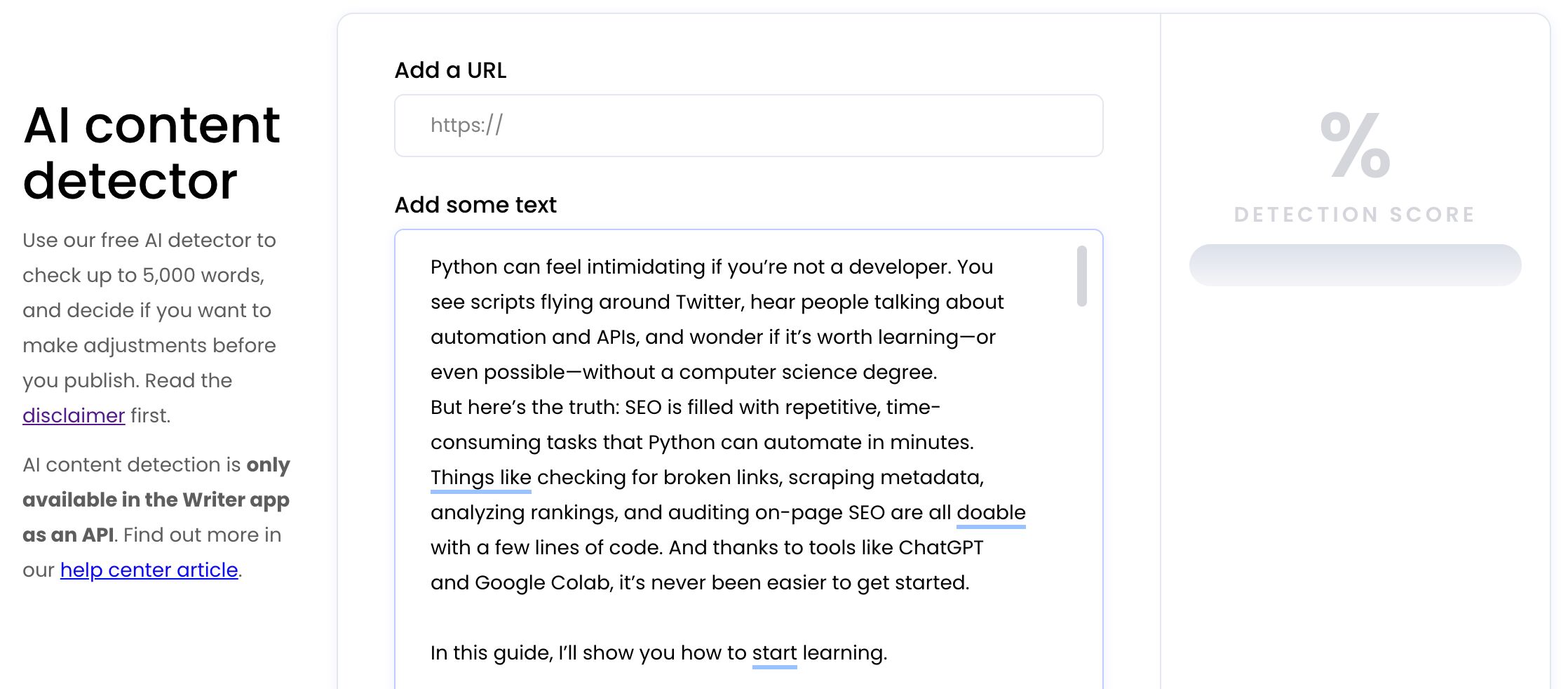
We recently launched our new AI detector. For almost any webpage, you can analyze the likelihood that AI was used to create it, highlight AI-generated sections of text, and even identify the specific AI models used to create the text.
There are tons of AI detectors available. And, while ours is the only one that can also show you any webpage’s backlinks and estimated search traffic, how the page content has changed over time, and how it performs relative to other pages…
…we still wanted to know how Ahrefs’ AI detector compares to other popular detectors. So we tested it.
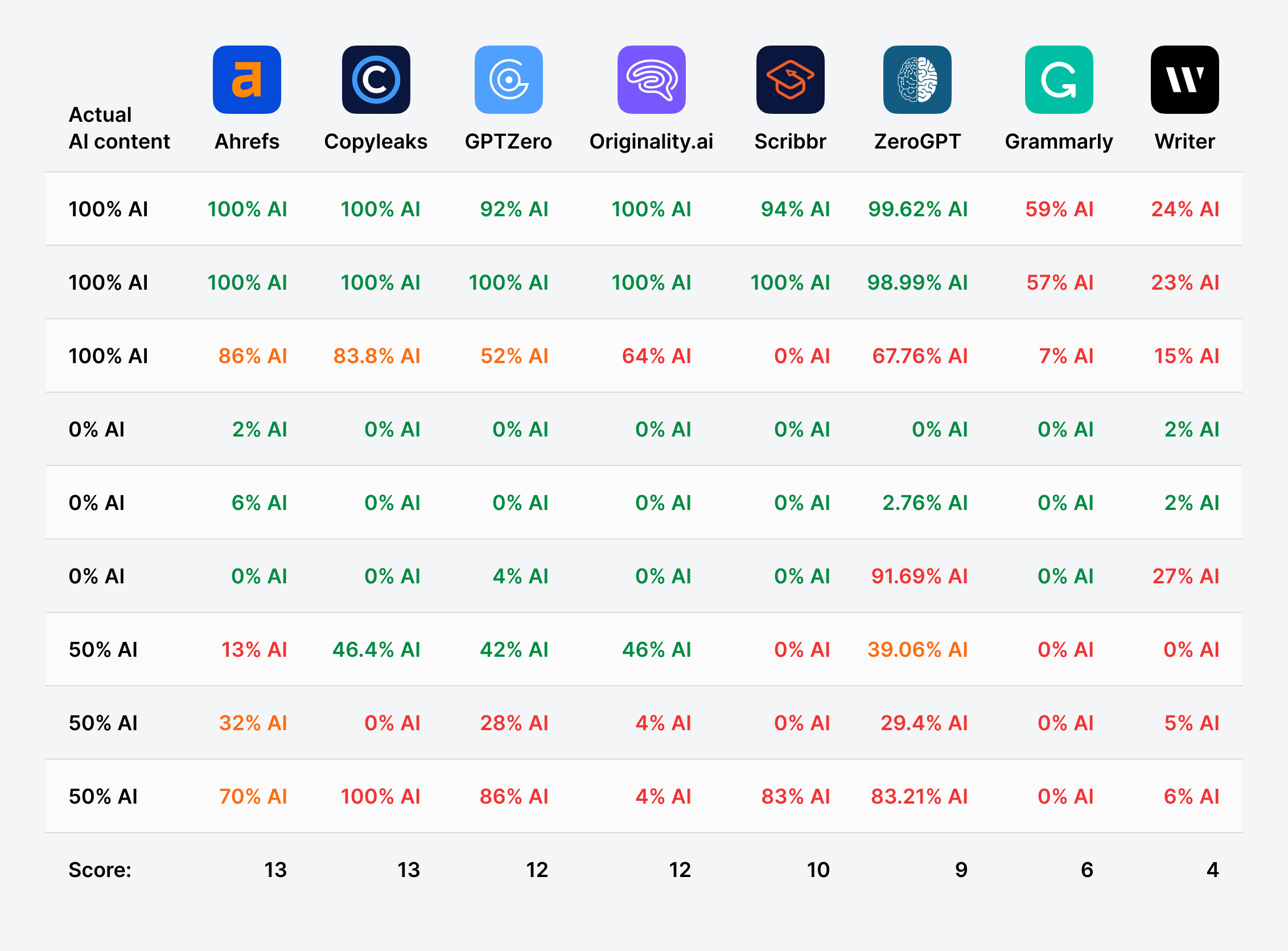
Interestingly, false positives were not a big issue. Only 2/24 tests run on human-written content incorrectly flagged the text sample as AI-generated. All the AI detectors struggled the most with the hybrid human/AI content (for reasons explained below).
In the table below, you can see the actual AI content of each test article, followed by each tool’s analysis:
| Actual AI% | Ahrefs | Copyleaks | GPTZero | Originality.ai | Scribbr | ZeroGPT | Grammarly | Writer |
|---|---|---|---|---|---|---|---|---|
| 100% | 100% | 100% | 92% | 100% | 94% | 99.62% | 59% | 24% |
| 100% | 100% | 100% | 100% | 100% | 100% | 98.99% | 57% | 23% |
| 100% | 86% | 83.8% | 52% | 64% | 0% | 67.76% | 7% | 15% |
| 0% | 2% | 0% | 0% | 0% | 0% | 0% | 0% | 2% |
| 0% | 6% | 0% | 0% | 0% | 0% | 2.76% | 0% | 2% |
| 0% | 0% | 0% | 4% | 0% | 0% | 91.69% | 0% | 27% |
| 50% | 13% | 46.4% | 42% | 46% | 0% | 39.06% | 0% | 0% |
| 50% | 32% | 0% | 28% | 4% | 0% | 29.4% | 0% | 5% |
| 50% | 70% | 100% | 86% | 4% | 83% | 83.21% | 0% | 6% |
| Score | 13 | 13 | 12 | 12 | 10 | 9 | 6 | 4 |
Ahrefs’ AI Detector
Score: 13/18
URL: https://ahrefs.com/writing-tools/ai-content-detector
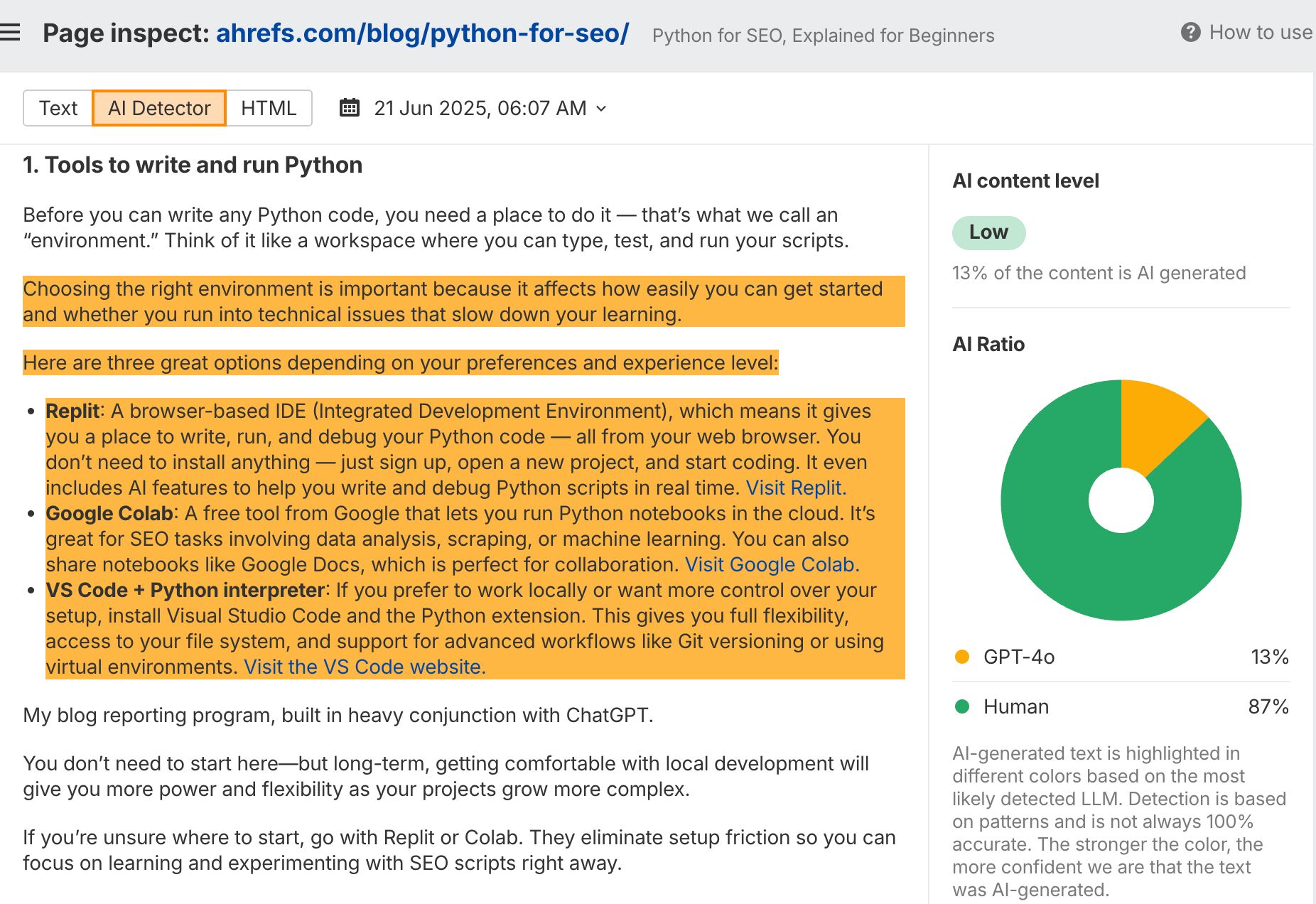
Ahrefs AI Detector showed good accuracy across the board, with no false positives for human-written content, and good detection for AI content. It also managed to detect the specific model types used for the AI content: GPT-4o and Meta’s Llama.
By my criteria, it failed one out of nine tests, struggling to identify AI content that was blended with human writing. This is a known limitation of all AI detection tools (more on that below), and was true of all detection models.
Ahrefs AI detector is based on our own proprietary detection model, trained on a huge amount of web content. It’s unique among AI detectors because you can use it in conjunction with tons of other Ahrefs data points to see how content actually performs.
You can use Ahrefs’ AI detector to see:
- Which AI models are the best for creating high-quality content.
- How often your competitors publish AI content, and which models they use.
- How much AI content is present in a particular SERP, and how much effort you might need to invest to rank.
- How organic performance metrics correlate with different levels of AI use, like search traffic, keyword rankings, and backlinks.
- Whether AI content use correlates with traffic drops on particular pages or in particular subfolders.
How to use Ahrefs’ AI detector
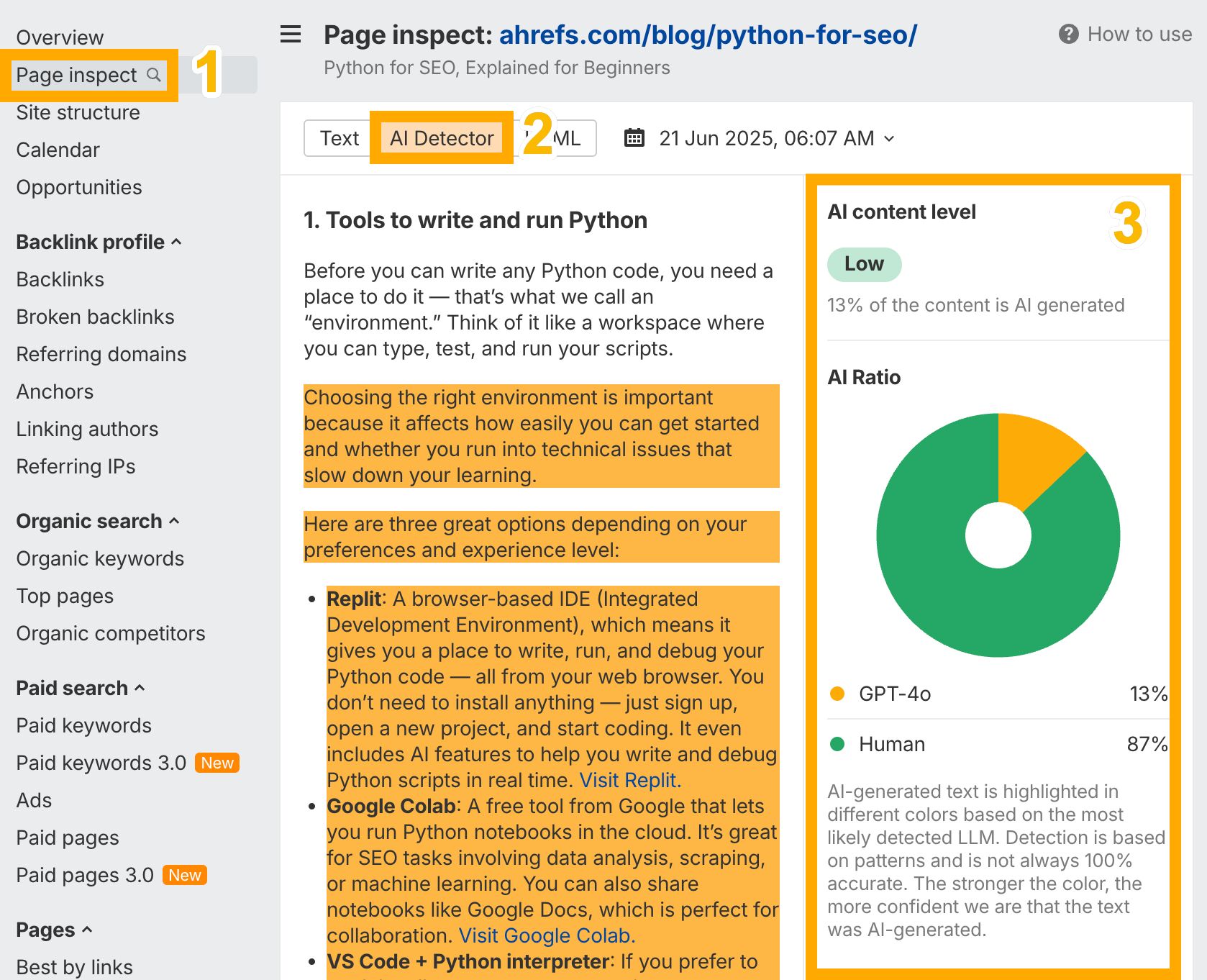
Start by heading to Site Explorer and pasting the URL you want to analyse. From there:
- Click the Page inspect report tab in the left sidebar.
- Choose the AI Detector tab.
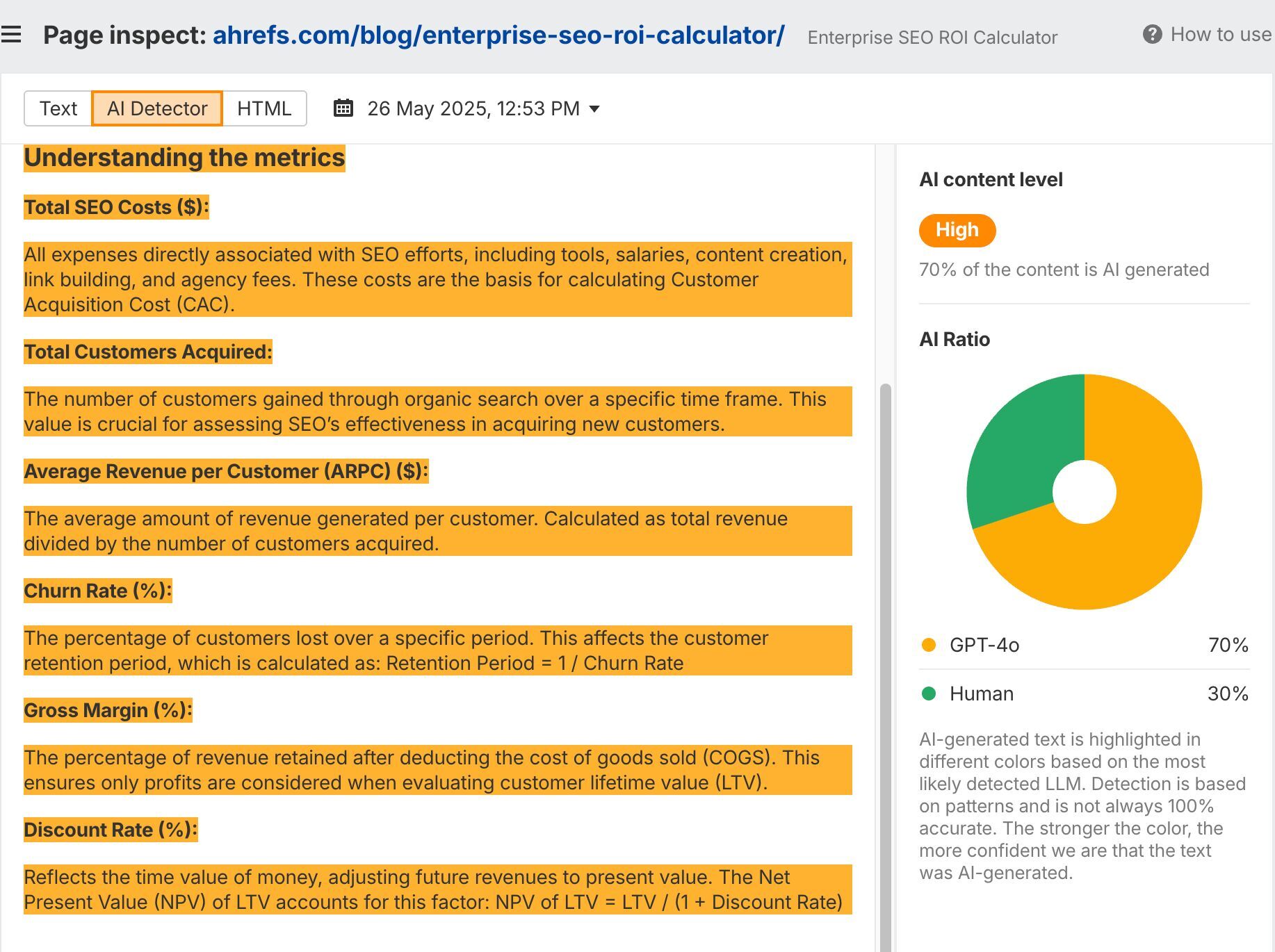
- See your AI content level report in the right sidebar. Text that our model has detected as likely AI-generated will be color-coded according to the colors in the pie chart
In this example, our AI detector has found a section of my blog post that I used ChatGPT’s GPT-4o model to generate:
From there, you can also see how the page content has changed over time, how many backlinks it has earned, how many keywords it ranks for, how much estimated organic traffic it receives…
You can also test out the model via our free AI content detector page. We’re also adding bulk AI content detection to the Top pages report in Site Explorer (coming soon).
Copyleaks
Score: 13/18
URL: https://copyleaks.com/ai-content-detector
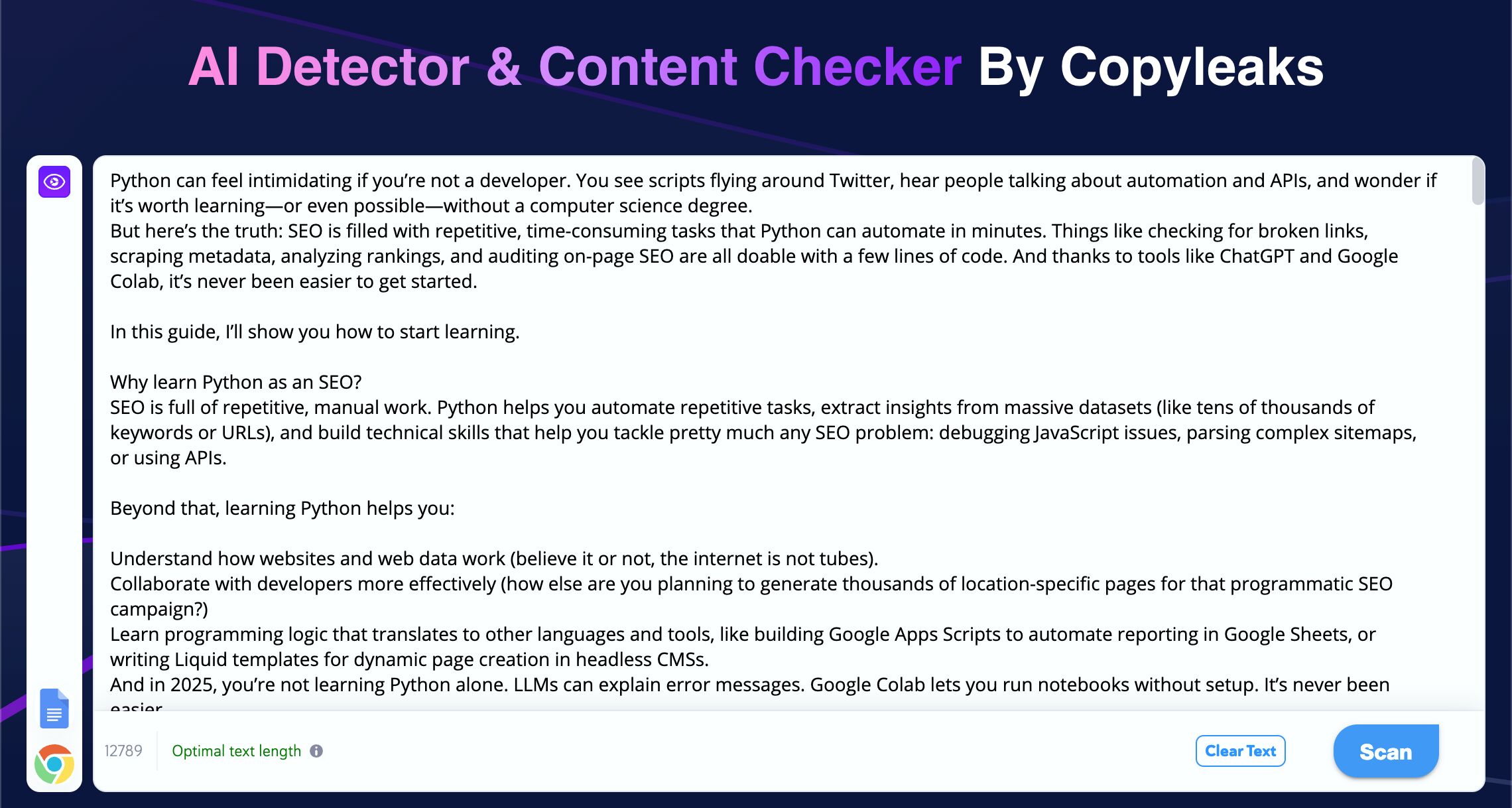
Copyleaks matched the top score, showing solid detection ability across both extremes of AI content. It proved especially effective at catching obvious AI writing, though it occasionally faltered in mixed or borderline passages.
GPTZero
Score: 12/18
URL: https://gptzero.me
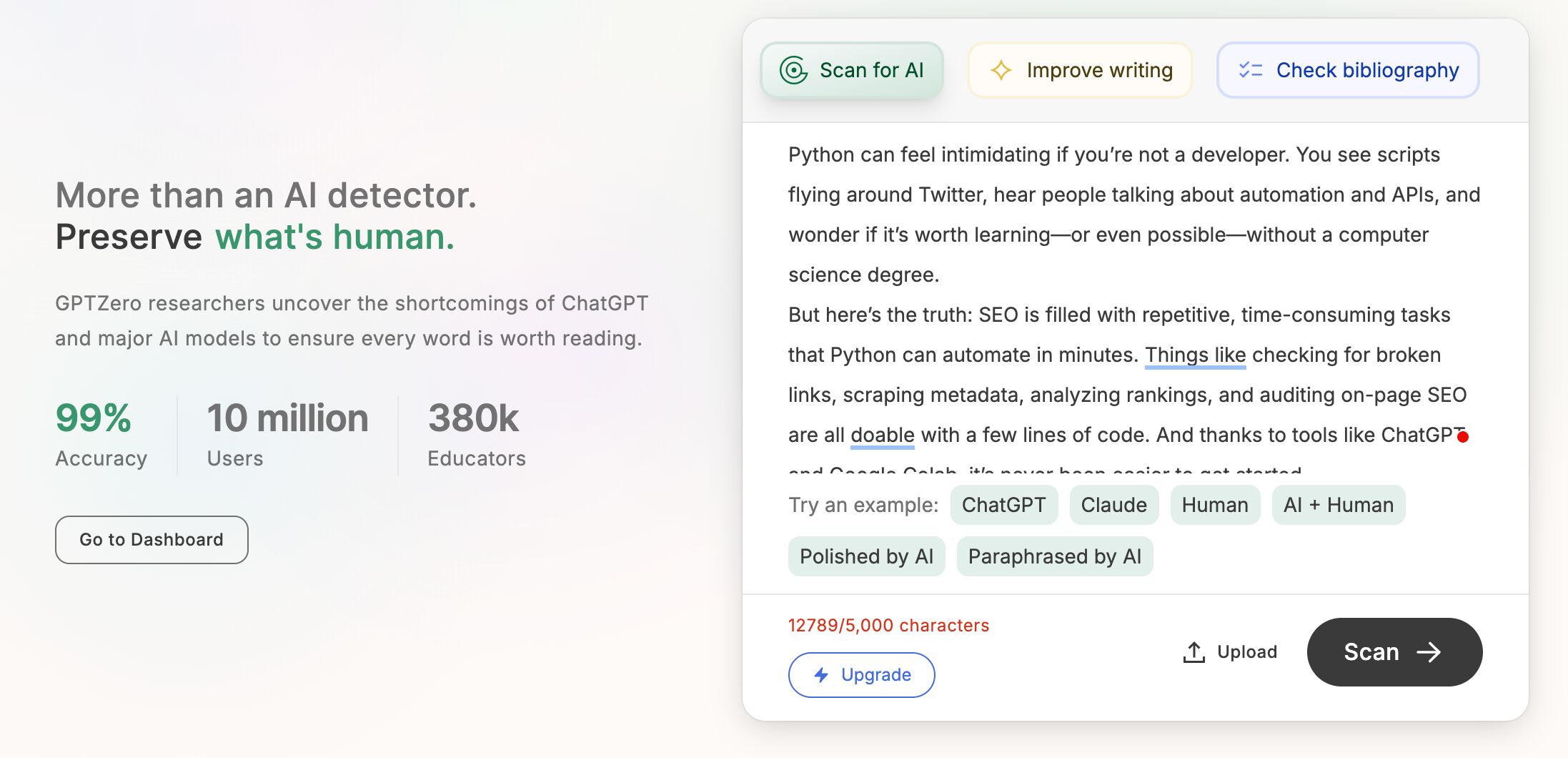
GPTZero offered reliable results overall, with a clear strength in catching high-percentage AI content. However, it sometimes hesitated in assigning confident AI probabilities to mid-range or hybrid examples, slightly affecting its total accuracy.
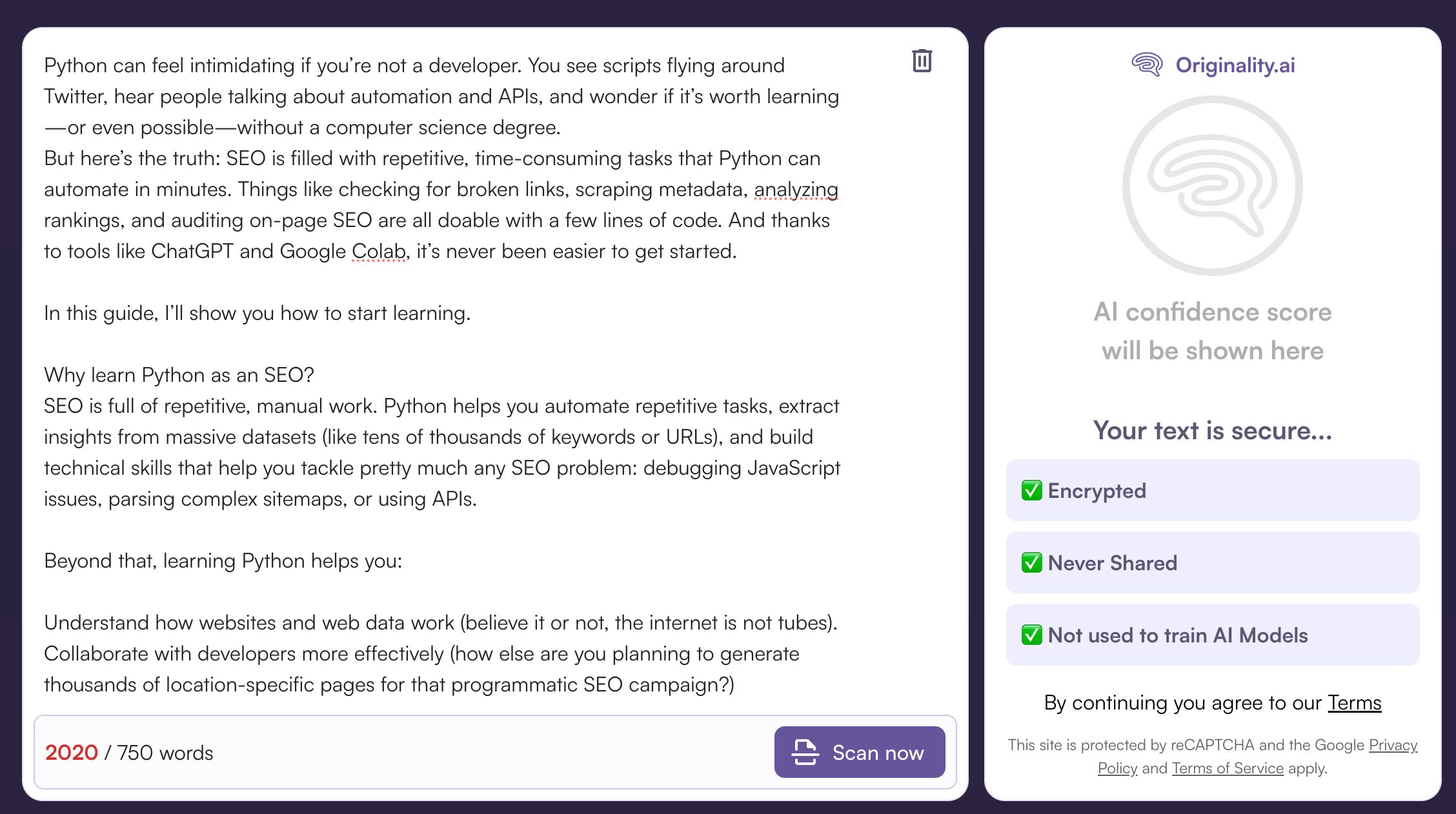
Originality.ai
Score: 12/18
URL: https://originality.ai/ai-checker
Originality.ai performed well in most cases, accurately flagging AI-heavy text but showing a tendency to overestimate human authorship when faced with subtle or well-edited AI-generated material.
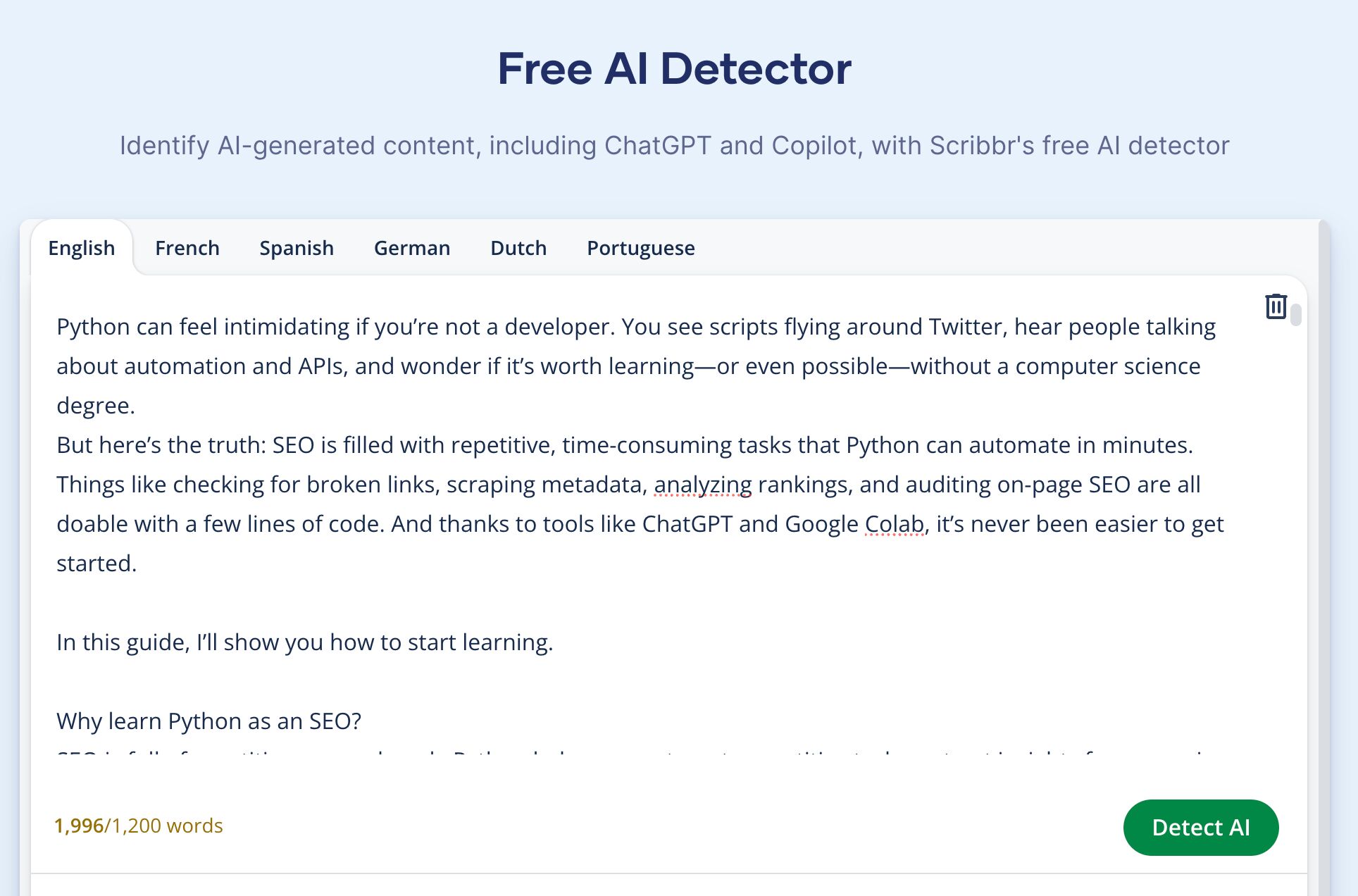
Scribbr
Score: 10/18
URL: https://www.scribbr.com/ai-detector/
Scribbr landed in the middle of the pack, handling clear-cut AI content reasonably well but displaying a drop in performance on more nuanced pieces, where its predictions tended to be inconsistent or overly cautious.
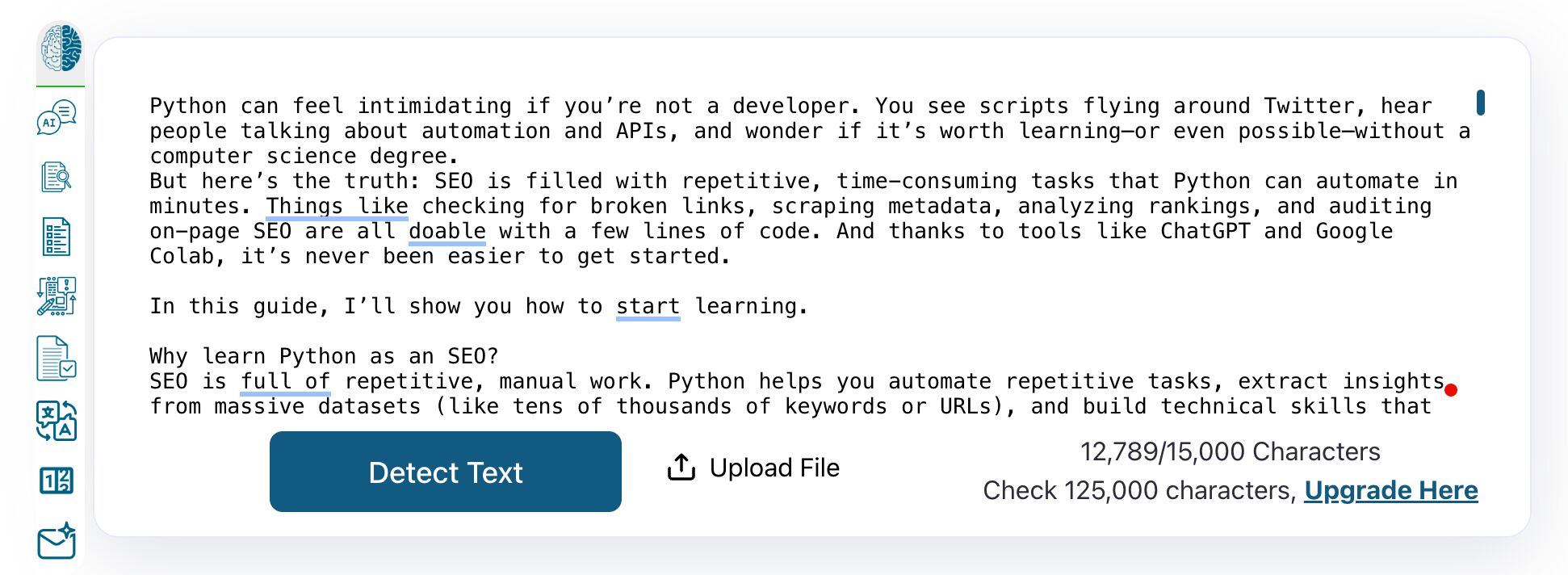
ZeroGPT
Score: 9/18
URL: https://zerogpt.com
ZeroGPT’s performance was uneven—it occasionally nailed high-AI content but frequently misclassified partial-AI and low-AI samples. The tool’s sensitivity seemed skewed toward extremes, resulting in a less balanced profile.
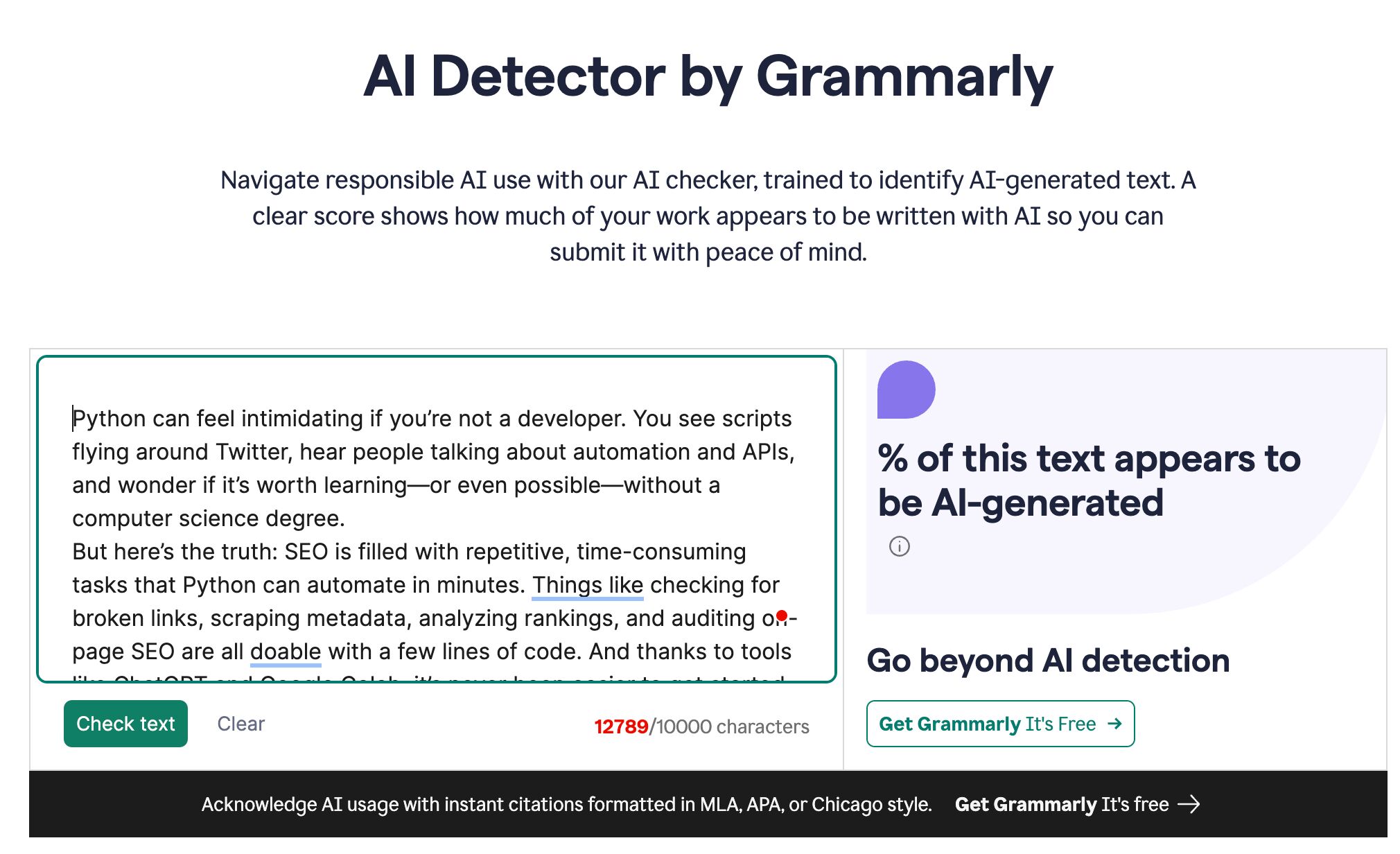
Grammarly
Score: 6/18
URL: https://www.grammarly.com/ai-detector
Grammarly’s free AI detector struggled with accurate AI detection, offering low-confidence or inaccurate predictions in many cases. It often failed to recognize clear signs of AI authorship and was unreliable on mixed or borderline content.
Writer
Score: 4/18
URL: https://writer.com/ai-content-detector/
Writer’s free AI detector scored the lowest, frequently misidentifying or entirely missing AI-generated material. It lacked precision across the board and provided little useful signal even when dealing with content that was 100% AI-written.
Further reading
Similar Posts
10 Best Hostinger Alternative 2025, Sep | Top Competitors
When it comes to affordable web hosting services, Hostinger is often one of the first names that pops up. It’s budget-friendly, beginner-friendly, and offers a simple platform for individuals starting their online journey. However, when it comes to handling enterprise-level workloads that need powerful hosting solutions, the question comes, Can Hostinger provide big dedicated solutions?…
7 Best Web Hosting Germany 🇩🇪 2025 – [In-depth Reviewed]
Targeting or trying to reach German audiences or readers for your website and looking for hosting platforms for it? Are you a blogger or the owner of a website and desiring to spread your words in Germany? In both the cases, you need a web hosting provider with better uptime, speed and data centers. Stick…
How to Rank in AI Overviews: What Actually Works (Based on Data, Not Speculation)
Most advice on ranking in AI Overviews is speculative, so we’ve analyzed millions of AI Overview responses, reviewed third-party research, and studied Google’s guidance to find out what actually works. Our own study shows that AI Overviews have caused click-through rate drops of 34.5%, with new research from Seer Interactive reporting drops as high as…
9 Best 1 Dollar Web Hosting Providers in February 2026 – Top Reviewed
Are you a student, struggling professional, wanting to start a website to display your school projects, researches or portfolio online, but you’re having less budget? If so, then stay on this page, as here, we’re gonna list you the best 1 dollar web hosting providers that offer incredible website hosting services just @ $1, ensuring…
2024 Black Friday trends: Top strategies from Woo stores and partners
We published our Black Friday Cyber Monday report in September knowing the data was just the beginning. The trends surrounding these major online sales made sense: Stock up on inventory, optimize your customer experience, diversify your payment options, make sure your site can handle the traffic, and let online shoppers know that cyber week sales…
Those Non-Design Technologies Web Designers Need to Know – Speckyboy
We call ourselves web designers and developers. However, the job often goes beyond those narrow margins. Freelancers and small agencies deal with a range of non-design and coding issues. We become the first person our clients contact when they have a question. It happens – even when we aren’t directly involved with the subject matter….

![7 Best Web Hosting Germany 🇩🇪 2025 - [In-depth Reviewed]](https://gooooood.net/wp-content/uploads/2025/05/7-best-web-hosting-germany-f09f87a9f09f87aa-2025-in-depth-reviewed.png)