The cybersecurity landscape has been dramatically reshaped by the advent of generative AI. Attackers now leverage large language models (LLMs) to impersonate trusted individuals and automate these social engineering tactics at scale.
Let’s review the status of these rising attacks, what’s fueling them, and how to actually prevent, not detect, them.
The Most Powerful Person on the Call Might Not Be Real
Recent threat intelligence reports highlight the growing sophistication and prevalence of AI-driven attacks:
In this new era, trust can’t be assumed or merely detected. It must be proven deterministically and in real-time.
Why the Problem Is Growing
Three trends are converging to make AI impersonation the next big threat vector:
- AI makes deception cheap and scalable: With open-source voice and video tools, threat actors can impersonate anyone with just a few minutes of reference material.
- Virtual collaboration exposes trust gaps: Tools like Zoom, Teams, and Slack assume the person behind a screen is who they claim to be. Attackers exploit that assumption.
- Defenses generally rely on probability, not proof: Deepfake detection tools use facial markers and analytics to guess if someone is real. That’s not good enough in a high-stakes environment.
And while endpoint tools or user training may help, they’re not built to answer a critical question in real-time: Can I trust this person I am talking to?
AI Detection Technologies Are Not Enough
Traditional defenses focus on detection, such as training users to spot suspicious behavior or using AI to analyze whether someone is fake. But deepfakes are getting too good, too fast. You can’t fight AI-generated deception with probability-based tools.
Actual prevention requires a different foundation, one based on provable trust, not assumption. That means:
- Identity Verification: Only verified, authorized users should be able to join sensitive meetings or chats based on cryptographic credentials, not passwords or codes.
- Device Integrity Checks: If a user’s device is infected, jailbroken, or non-compliant, it becomes a potential entry point for attackers, even if their identity is verified. Block these devices from meetings until they’re remediated.
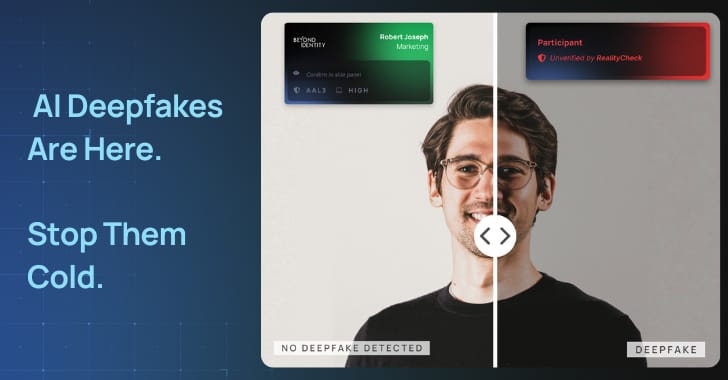
- Visible Trust Indicators: Other participants need to see proof that each person in the meeting is who they say they are and is on a secure device. This removes the burden of judgment from end users.
Prevention means creating conditions where impersonation isn’t just hard, it’s impossible. That’s how you shut down AI deepfake attacks before they join high-risk conversations like board meetings, financial transactions, or vendor collaborations.
| Detection-Based Approach | Prevention Approach |
|---|---|
| Flag anomalies after they occur | Block unauthorized users from ever joining |
| Rely on heuristics & guesswork | Use cryptographic proof of identity |
| Require user judgment | Provide visible, verified trust indicators |
Eliminate Deepfake Threats From Your Calls
RealityCheck by Beyond Identity was built to close this trust gap inside collaboration tools. It gives every participant a visible, verified identity badge that’s backed by cryptographic device authentication and continuous risk checks.
Currently available for Zoom and Microsoft Teams (video and chat), RealityCheck:
- Confirms every participant’s identity is real and authorized
- Validates device compliance in real time, even on unmanaged devices
- Displays a visual badge to show others you’ve been verified
If you want to see how it works, Beyond Identity is hosting a webinar where you can see the product in action. Register here!